

Plaud + a self-hosted transcriber + Claude skill + PM CodexHi all! I wanted to share the bigger setup of my project management workflow using PM Codex, since a few pieces might be useful to people here even if you never touch PM Codex. The problem I have 1–3 hours of meetings a day. They’re bilingual, full of jargon, and people talk over each other. I record them on a Plaud Note Pro and Plaud Desktop, but I didn’t want Plaud’s subscription because I'm cheap. My local GPU was too weak to transcribe well, so I built my own pipeline in the cloud. Plaud Note Pro raw audio │ ▼ Claude scheduled task finds new recordings, submits them │ ▼ Cloud Transcriber (Modal) diarize · transcribe · name speakers │ ▼ Auricle (Claude) clean up · confirm speakers · draft MoM │ ▼ PM Codex change request to be reviewed 1. Plaud: raw audio only The official Plaud connector fetches the recording file. I don’t use any of Plaud’s paid transcription or summary features. 2. Claude scheduled task: hands-free pickup A Claude scheduled task runs in the cloud every hour during working hours on weekdays, so my computer doesn’t need to be on. Each run: Looks through my Plaud recordings from the last few days. Skips anything too short to be a meeting, anything unusually long, and anything that’s already been sent. Sends the remaining recordings to the transcriber and doesn’t wait for them to finish. Cleans up old transcription jobs. Reports back in one to three lines. It’s deliberately simple. It never asks questions, never touches PM Codex, and never guesses who’s speaking. It runs on a small, fast Claude model with automatic approval, so it costs almost nothing. By the time I sit down to review a meeting, the transcript is usually already waiting. 3. Cloud Transcriber: diarized ASR on Modal It runs on serverless GPUs that are billed per second and scale to zero. For each recording: pyannote works out who spoke when. Whisper large-v3, Qwen3-ASR and Qwen3-Omni (on vLLM) each transcribe every speaker turn. An ensemble keeps, for each turn, the version the engines agree on most. It flags likely hallucinations instead of silently deleting them. Voiceprints name the speakers. A speaker is named automatically only when the match is strong and clearly ahead of the next candidate. Otherwise it asks me. It costs about $0.25 per audio hour, which fits inside Modal’s free monthly credit for my usage. Before each job it checks how much credit is left and switches to a free fallback if there isn’t enough. 4. Auricle: the workflow layer (a Claude skill) When I say “Run auricle for a meeting at 2PM”, Claude picks up the finished transcript, or starts one if the scheduled task hasn’t picked up that recording yet. It cleans up the transcript using a glossary and the attendee list pulled from PM Codex. This fixes misheard names and acronyms. It asks me only about speakers it couldn’t identify, and shows example quotes so I can tell who’s who. It learns from my answers: confirmed speakers become voiceprints, and corrected terms go into the glossary. 5. Into PM Codex Auricle doesn’t write anything directly. It files one change request through the Claude bridge with the minutes, new tasks, risks and timeline updates. I review it and sign off in the app like any other change. What I learned Context beats model size. Giving the engines and the cleanup pass a glossary and attendee list did more than swapping engines. In my tests, the cleanup pass alone cut word errors by 3–6 points and recovered 20–35% more key terms. Combining engines beats any single one. My ensemble beat every engine on its own, and it also beat Plaud’s built-in transcript on the same audio. Crowded rooms are still hard. Every engine struggles with who said what when people talk over each other. Voiceprints are good for naming speakers but don’t fix that. Voiceprints are biometric data. If you build something similar, check your local privacy rules and make it easy for people to delete theirs. The transcriber and the Auricle skill aren’t public yet, but I’m happy to answer questions about the approach. If you’ve wired PM Codex into your own capture or transcription tools, I’d love to hear how!
Apps
Announcements



Phosphene 4.19.5 - Hailuo H3 stays on tested versionsHailuo H3 used to install the newest version of every library it uses on the day you installed it, so one bad library update could break every new H3 install. H3 now installs the exact set of versions it was tested with, every time. This Update puts an existing H3 install on that set (about a minute, no weights downloaded). Your H3 videos come out the same as before. If H3's libraries ever drift again (a manual install, an interrupted Update), H3 stops in a second, before it uses the GPU, and the card offers Repair Hailuo H3 - one click, about a minute, every weight kept. LTX renders are not affected. Also since the 4.19 post: renders that a library update broke work again (4.19.4), Phosphene no longer touches your GitHub login (4.19.3), and Ingredients, LTX 2.3/2.5 switching and Linux on Apple Silicon landed with community fixes (4.19.2). Press Update in Pinokio, then restart. https://github.com/mrbizarro/Phosphene/releases/tag/v4.19.5

Continuum Update (v2026‑10‑14)Continuum now supports two ways to build longer videos: Single Prompt: Repeat one prompt across the selected number of sections. Per Section: Write a separate prompt for each section. What’s improved Fixed an issue that could regenerate earlier sections when extending a video. Added shared character and setting text for every new section. Added Balanced (22 frames) and experimental Strong (39 frames) transition context. Continuations preserve the original seed, model settings, shared context and transition preset. The interface now shows existing duration + added duration = total duration. Validated with Studio Draft settings: 480p, 12 steps, 5 + 5 seconds. Saved-section reuse was confirmed, and both stickman fighters remained in the scene as the action continued into combat. Spectrum compatibility: Spectrum is bypassed in Continuum because it interfered with safe saved-section reuse. It remains available for ordinary H3 generation. Older Spectrum-enabled Continuum runs require a new series; existing videos are preserved. Continuum remains experimental. Character details, camera, lighting and motion can still drift. Strong context is not always better, so Balanced remains the default. Audio continuity and longer sequences need further testing. Update through Pinokio, restart Studio when the queue is idle, and refresh the page. ☕ Support development: https://buymeacoffee.com/erdindev












Higgs Audio v3 TTS + AI text director, voice cloning, podcast & audiobook (multi-speaker). 100+ languages, offline, NVIDIA GPU.
 @nerual_dreming6 check-ins

Suno at home. Local AI music generation studio — full songs with vocals, lyrics, covers, and music videos. Built on ACE-Step 1.5 XL.
@nerual_dreming7 check-ins
ElevenLabs at home. Multilingual TTS with Voice Design, Voice Cloning, and end-to-end LoRA fine-tuning straight from a video or podcast. Built on VoxCPM2 by OpenBMB. 30 languages incl. Russian.
@nerual_dreming3 check-ins
Hermes AgentFeatured
Self-improving CLI agent by Nous Research with local memory, skills, and messaging workflows.
 @cocktailpeanut


 13 check-ins
1-click MiniMax H3 video in ComfyUI plus H3 Studio: local T2V/I2V, references, continuation, Gallery, Director/Cinema and TR/EN. NVIDIA GPU.
 @mvrdvk

 18 check-ins







Build, curate, caption and clean LoRA training datasets in your browser, then train, compare and iterate — local Flask app, your files stay on your disk. https://github.com/perfectgf/lora-dataset-studio


Flexible Automapper for Beatsaber made for any difficulty

Lightricks LTX-2.3 video generation (22B distilled-1.1) with a Gradio UI. Auto-detects GPU and configures offload.


 16 check-ins


Transcription & Audio Cleanup Tool with noise removal and stutter detection
 @c0m3b4ck1 check-in

Fully offline speech-to-text transcription with 11 local AI models. Generates styled subtitles (SRT, ASS) and burns them directly onto video. Supports Whisper, Parakeet, Canary, Moonshine, SenseVoice, Vosk, and more. No API keys required.
@c0m3b4ck3 check-ins
Fully offline document-to-speech converter using Coqui TTS models (XTTS v2, Bark, VITS, YourTTS) and StyleTTS 2. Converts EPUB, PDF, DOCX, HTML, and TXT files to audio with voice cloning support. No API keys or cloud services required.

Multi-voice text-to-speech for stories and audiobooks, with local and cloud TTS engines plus optional LLM text processing.
 @xerophayze


 5 check-ins
Local video manager with AI autotagging and optional SeedVR2 upscale, powered by VLC
@saffmila
 3 check-ins
MiniMax H3 ComfyUIFeatured
MiniMax H3 omni-modal video generation in ComfyUI. Text/image/video/audio in, video with native 32kHz stereo audio out (768p default, 1080p+ supported). Disk-optimized: pruned INT8 + NVFP4 weights (~63GB instead of ~290GB). NVIDIA only.
 @thomas_eric


 56 check-ins

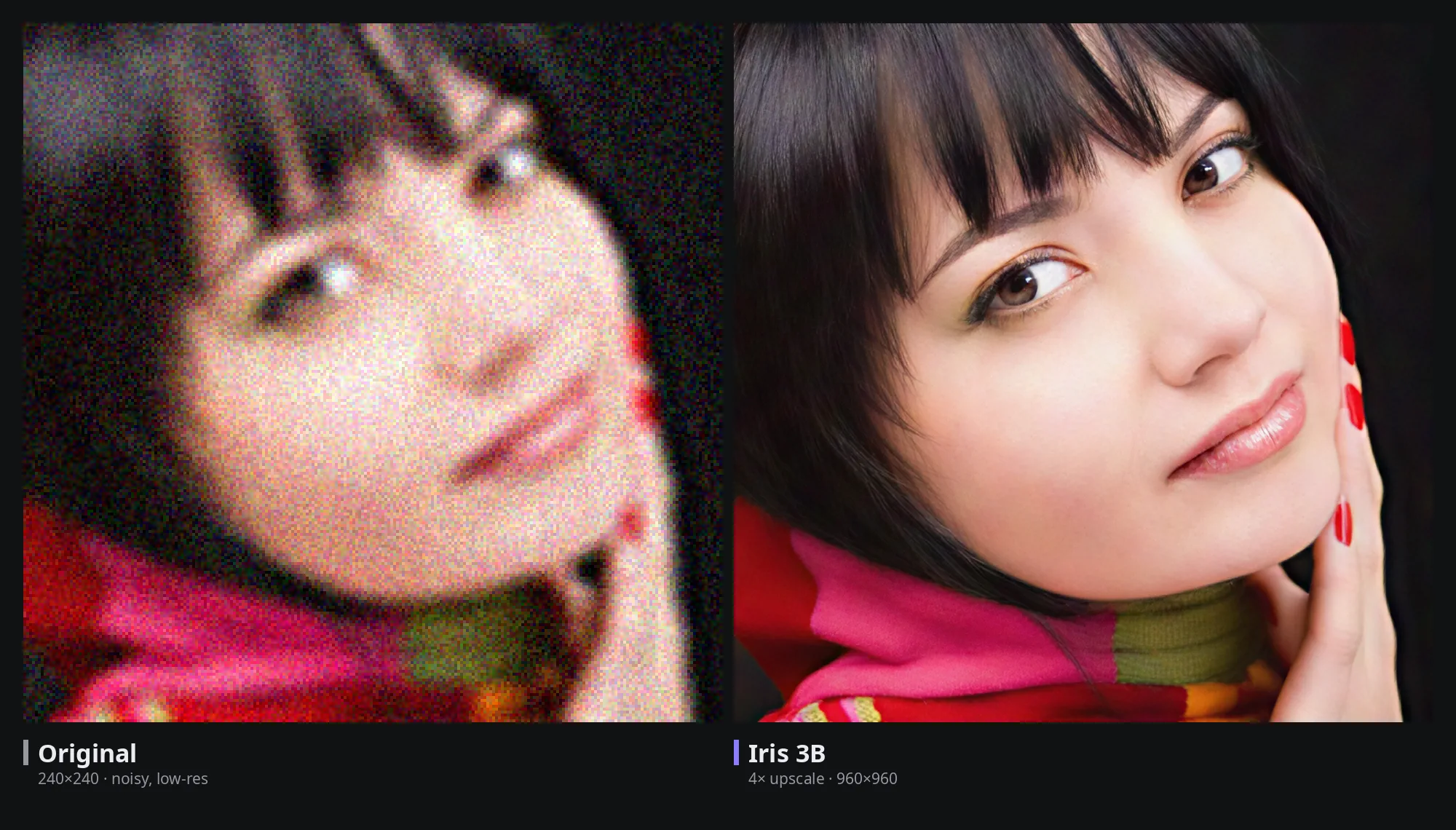
Speridlabs Iris-3B pixel-space diffusion: text-to-image, monocular depth, and image restoration / 4x upscaling in one local Gradio UI. NVIDIA GPU recommended (16 GB+); Apple Silicon and CPU work but are slow.
@thomas_eric3 check-ins